
Introduction
Ulugh Beg (1394–1449), a Timurid prince, was one of the most notable figures in the history of medieval science. Known as a statesman, scholar, and astronomer, his contributions to the field of astronomy during the Islamic Golden Age significantly shaped the development of both Islamic and Western science. His construction of the observatory in Samarkand, and the creation of the highly accurate star catalogue Zij-i Sultani, are recognized as pioneering achievements.
The Timurid Empire and Ulugh Beg’s Role in Politics and Science
Ulugh Beg was born into the illustrious Timurid dynasty, the ruling family of the empire founded by his grandfather, Timur (Tamerlane). The Timurids ruled over a vast region, stretching from Persia to Central Asia. Despite being primarily known for his scholarly pursuits, Ulugh Beg held important political responsibilities, governing Samarkand, the cultural capital of the Timurid Empire.
Samarkand, under Ulugh Beg’s leadership, became a hub of intellectual activity. The city’s cultural and academic flourishing was in part due to Ulugh Beg’s patronage of the sciences, especially astronomy and mathematics. His court attracted scholars from across the Islamic world, and he ensured that Samarkand became a center for scientific research.
The Samarkand Observatory: A Masterpiece of Medieval Science
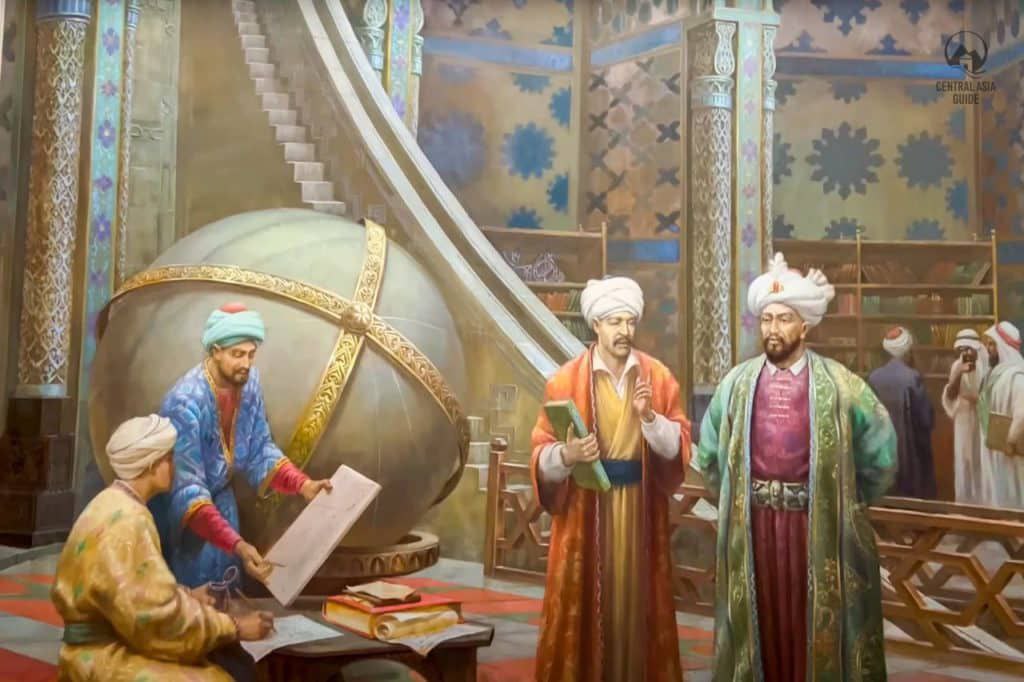
One of Ulugh Beg’s most significant achievements was the construction of the Ulugh Beg Observatory, completed around 1420. Situated on the Kuhak Hill outside Samarkand, the observatory was an architectural and scientific marvel. It was among the largest and most advanced astronomical observatories of its time, and it served as a crucial hub for astronomical research in the Islamic world. Ulugh Beg’s vision for the observatory was not only as a ruler but as a scholar deeply committed to advancing scientific knowledge.
Design and Instruments
The observatory was known for its massive instruments designed to improve the precision of astronomical measurements. One of the most notable features was a giant meridian arc, a semi-circular instrument used to measure the positions of celestial bodies as they crossed the local meridian. This arc was 40 meters in radius, which allowed for unprecedented accuracy in determining the angles of stars.
The observatory also housed several other large instruments, including armillary spheres and astrolabes, which were used to chart the stars and planets.
The accuracy of these instruments enabled Ulugh Beg and his team to make remarkably precise observations. For instance, they calculated the length of the solar year as 365 days, 5 hours, 49 minutes, and 15 seconds—only a few seconds off from modern measurements. This level of precision placed the observatory on par with, if not ahead of, its European counterparts for centuries.
Scientific Collaborations
Ulugh Beg did not work alone in this scientific endeavor. He was accompanied by some of the most distinguished scholars of his time, including Qadi Zada al-Rumi, a renowned mathematician and astronomer, and Ali Qushji, a prominent scientist who would later contribute significantly to the field of astronomy in the Ottoman Empire. Together, they meticulously cataloged the positions of stars, producing the Zij-i Sultani.
The observatory also served as a learning center for future astronomers and mathematicians, training a new generation of scholars in the methods of precise observation and calculation. Its influence reached far beyond the borders of the Timurid Empire, contributing to scientific developments in both the Islamic world and, later, Europe.
The Decline and Rediscovery of the Observatory
Unfortunately, the Samarkand Observatory did not survive long after Ulugh Beg’s assassination in 1449. Religious and political tensions within the Timurid dynasty led to its eventual neglect, and by the end of the 15th century, the observatory had fallen into ruin. It wasn’t until the early 20th century that the remains of the observatory were rediscovered by Russian archaeologist V. L. Vyatkin, who unearthed the foundation and part of the massive meridian arc, confirming the advanced nature of Ulugh Beg’s scientific work.
The Zij-i Sultani: Ulugh Beg’s Legacy in Astronomy
The Zij-i Sultani was completed in 1437 and represents one of Ulugh Beg’s greatest scientific legacies. This star catalogue included the precise positions of over 1,000 stars and was the most accurate compilation of celestial data since the work of Ptolemy. Ulugh Beg’s astronomical team measured the length of the solar year with a precision that exceeded earlier Islamic astronomers and even rivaled that of later European scientists.
The catalogue also provided detailed information on planetary movements, lunar and solar eclipses, and astronomical tables for use in navigation. Its precision and scope made it a foundational text for both Islamic and Western astronomers well into the Renaissance. The Zij-i Sultani’s influence extended to the work of Copernicus and later European scientists, demonstrating the profound global impact of Ulugh Beg’s scholarship.
The Madrasas of Ulugh Beg: Centers of Learning and Scientific Inquiry
In addition to his work in astronomy, Ulugh Beg was a major patron of education, establishing several madrasas (Islamic colleges) that became famous centers of learning during his reign. The most well-known of these is the Ulugh Beg Madrasa in Samarkand, located on the famous Registan Square, the heart of the city’s intellectual and cultural life. The madrasa, completed in 1420, was one of the earliest built during the Timurid era and is considered one of the architectural jewels of Central Asia.
Architecture and Design
The madrasa’s architectural design reflects the grandeur of the Timurid style, with its intricate mosaic tilework, arched entrances, and large domes. The building’s façade is adorned with calligraphy and geometric patterns that showcase the intersection of art and science, a hallmark of the Timurid Renaissance. The madrasa was part of a larger educational complex that also included mosques and libraries, symbolizing Ulugh Beg’s commitment to fostering a scholarly environment.
The design of the madrasa, with its large iwan (vaulted hall) and two levels of classrooms and dormitories, was meant to house scholars and students from across the Islamic world. It could accommodate hundreds of students, who were taught a wide array of subjects, including astronomy, mathematics, theology, philosophy, and literature.
Curriculum and Scholarly Pursuits
What made Ulugh Beg’s madrasas particularly unique was their emphasis on scientific subjects alongside traditional Islamic studies. Astronomy and mathematics were given pride of place in the curriculum, reflecting Ulugh Beg’s own scholarly interests. The madrasa was not only a religious institution but also a scientific academy, where some of the brightest minds of the Islamic world gathered to study and exchange knowledge.
Ulugh Beg himself lectured at the madrasa, teaching astronomy and mathematics, making him one of the few rulers in history to actively participate in the intellectual life of his court. His lectures attracted scholars from as far as the Middle East and India, furthering the madrasa’s reputation as a center for learning. It is said that Ulugh Beg held discussions with students and scholars on complex subjects, blending theoretical knowledge with practical observations made at his observatory.
Impact on Science and Education
The Ulugh Beg Madrasa, along with other madrasas he established in cities like Bukhara, helped cement Samarkand’s status as a hub of intellectual activity. These institutions were part of a broader tradition of Islamic scholarship that promoted critical thinking, observation, and scientific inquiry. The madrasa produced many notable scholars who went on to make contributions to various fields, particularly astronomy and mathematics.
However, like the observatory, the madrasas declined in prominence after Ulugh Beg’s assassination and the subsequent political instability. Despite this, the intellectual legacy of these institutions persisted, with later generations of scholars continuing to draw upon the work done at Samarkand.

Uzbekistan 11 Days
Explore historic Silk Road cities such as Tashkent, Samarkand, Bukhara, and Khiva. This journey offers a deep dive into the rich heritage, architecture, and vibrant local culture that define these iconic destinations, including visits to UNESCO World Heritage sites and engaging with local traditions

Uzbekistan 9 Days
highlighting the stunning Silk Road cities. This journey includes visits to iconic sites, vibrant bazaars, and rich cultural experiences, providing a comprehensive insight into Uzbekistan's history and traditions.
Ulugh Beg’s Downfall: Political Struggles and Assassination
While Ulugh Beg’s scientific contributions were monumental, his political career was fraught with challenges. The Timurid Empire was plagued by internal strife, and Ulugh Beg found himself entangled in conflicts with other members of the royal family. His scientific pursuits also put him at odds with the conservative religious factions at court, who viewed his interest in astronomy and mathematics with suspicion.
In 1449, following a series of political intrigues and military defeats, Ulugh Beg was deposed by his son, Abd al-Latif. Shortly after his abdication, Ulugh Beg was assassinated, marking a tragic end to his career. His death symbolized the decline of the Timurid Empire and the fading of its scientific and cultural achievements.
Discover Uzbekistan with TravelSerai’s personalized tours, including Ulugh Beg’s iconic observatory, his historic madrasas, and his resting place in the stunning Gur-i Amir complex. Journey through history with us and experience the legacy of this remarkable scholar-king in an unforgettable way.


Comment (0)