
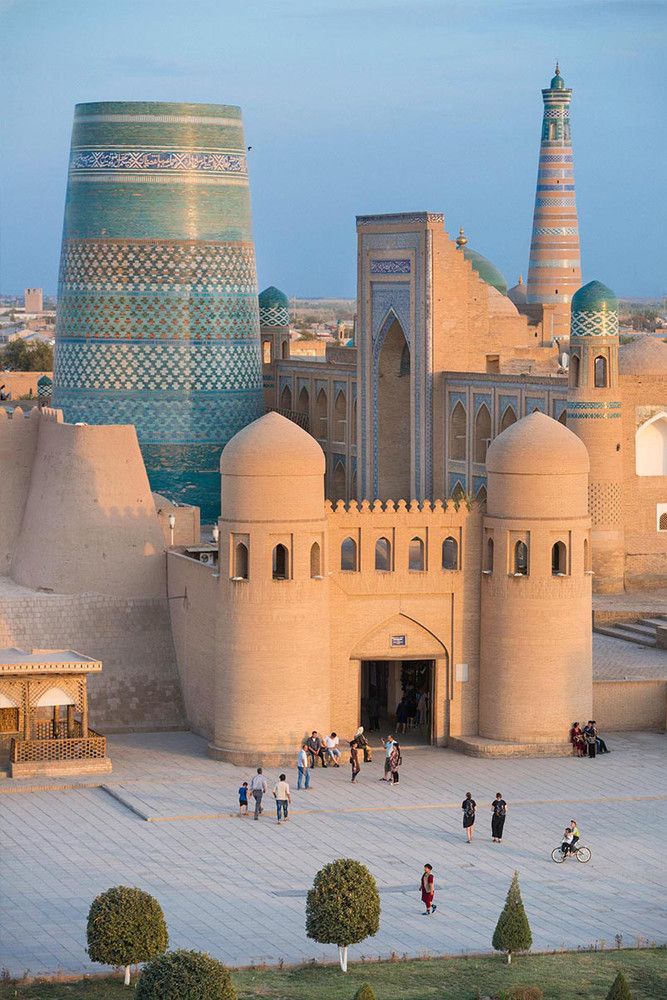
Nestled in the heart of the Kyzylkum Desert in Uzbekistan, Itchan Kala stands as a living testament to the rich history, culture, and architectural brilliance of Central Asia. This ancient walled city, located within the modern city of Khiva, is a UNESCO World Heritage Site and one of the most well-preserved examples of Islamic architecture in the region. Itchan Kala, which translates to “Inner Fortress,” is not just a collection of buildings; it is a portal to the past, offering visitors a glimpse into the grandeur of the Silk Road era and the enduring legacy of the Khorezm region. As one of the last major stops before entering Iran, it held great importance for travelers and traders navigating this historic route, bridging cultures and civilizations.
A Brief History of Itchan Kala
The origins of Itchan Kala date back over two millennia, with its foundations rooted in the ancient Khorezm civilization. The city of Khiva itself is believed to have been established around the 5th or 6th century BCE, though Itchan Kala, as we know it today, began to take shape during the 10th century. Over the centuries, Khiva grew in prominence as a vital stop along the Silk Road, the vast network of trade routes that connected the East and West.
Itchan Kala served as the administrative and cultural center of Khiva. The city was surrounded by formidable walls, which were rebuilt and reinforced multiple times over the centuries to protect against invasions. The walls, standing 8–10 meters high and 5–6 meters thick, stretch over 6,250 meters in perimeter and are made of mud bricks. These walls are punctuated by watchtowers every 30 meters, projecting outward and featuring crenellations for defense. Water-filled moats once added an extra layer of protection, remnants of which can still be seen in the southern part of the city.
The city reached its zenith during the 17th and 18th centuries when it became the capital of the Khanate of Khiva, a powerful Central Asian state. During this period, Itchan Kala was transformed into a thriving hub of trade, scholarship, and Islamic culture. The khans of Khiva commissioned the construction of mosques, madrasas (Islamic schools), palaces, and mausoleums, many of which still stand today as masterpieces of Islamic architecture.

Architectural Marvels of Itchan Kala
The Kunya-Ark Citadel
The Kunya-Ark, or “Old Fortress,” was the residence of the Khivan khans and the administrative heart of the khanate. Built in the 17th century, the citadel includes a throne room, a mosque, and a mint. The throne room, adorned with intricate blue and white tilework, is particularly striking, showcasing the artistry and craftsmanship of the period. The western wall of the Konya Ark and the ancient tower in the northeast corner of the castle wall have been preserved from the ancient period of Khorezm.

The Juma Mosque
One of the most iconic landmarks in Itchan Kala, the Juma Mosque, dates back to the 10th century, though it was extensively rebuilt in the 18th century. The mosque is renowned for its unique design, featuring a vast prayer hall supported by 212 wooden columns, each intricately carved with geometric and floral patterns. The columns, some of which date back to the original structure, are a testament to the enduring craftsmanship of Khorezmian artisans.

The Kalta Minor Minaret
The Kalta Minor Minaret, or “Short Minaret,” is one of the most recognizable symbols of Khiva. Commissioned by Muhammad Amin Khan in the 19th century, the minaret was intended to be the tallest in the Islamic world, reaching a height of 70 meters. However, construction was halted after the khan’s death, leaving the minaret at just 26 meters. Despite its unfinished state, the Kalta Minor is a stunning example of Khivan architecture, covered in vibrant blue, green, and white tiles.


Toshhovli Palace
The Toshhovli Palace, built in the 19th century, served as the official residence of the Khivan khans. The palace is a labyrinth of courtyards, halls, and living quarters, each adorned with exquisite tilework, carved wooden columns, and painted ceilings. The harem, in particular, is a highlight, featuring beautifully decorated rooms that offer a glimpse into the private lives of the khans and their families.
The Pakhlavan Mahmud Mausoleum
Dedicated to Pakhlavan Mahmud, a revered poet, wrestler, and saint, this mausoleum is one of the most sacred sites in Itchan Kala. The structure, built in the 14th century and expanded in the 19th century, is a masterpiece of Islamic architecture, with its turquoise dome and intricate tilework. The mausoleum is a place of pilgrimage for many, who come to pay their respects to the beloved saint.
Life in Itchan Kala
Itchan Kala is not just a museum of ancient architecture; it is a living, breathing city. Despite its historical significance, the walled city is still home to a small community of residents who continue to live and work within its walls. The narrow, winding streets are lined with traditional houses, many of which have been converted into guesthouses, shops, and workshops.
Visitors to Itchan Kala can immerse themselves in the vibrant culture of the city. Artisans craft traditional ceramics, textiles, and jewelry, while local bazaars offer a taste of Khivan cuisine, including plov (a rice dish), shashlik (grilled meat skewers), and fresh bread baked in traditional clay ovens. The city also hosts cultural festivals and events, celebrating the music, dance, and traditions of the Khorezm region.
Preservation and Challenges
The preservation of Itchan Kala is a remarkable achievement, given the challenges posed by time, climate, and urbanization. The city’s inclusion on the UNESCO World Heritage List in 1990 has played a crucial role in its conservation, providing funding and expertise for restoration projects. However, maintaining the delicate balance between preserving the past and accommodating modern needs remains a challenge.
Efforts to restore and protect Itchan Kala have involved meticulous work by local and international experts. Traditional building techniques and materials are used to ensure that the authenticity of the structures is preserved. At the same time, initiatives are underway to promote sustainable tourism, ensuring that the city’s cultural heritage is protected for future generations.

A Journey Through Time
Visiting Itchan Kala is like stepping into a time capsule. The city’s ancient walls, towering minarets, and ornate palaces transport visitors to a bygone era, when caravans laden with silk, spices, and precious gems traversed the Silk Road. Itchan Kala is more than just a historical site; it is a living testament to the resilience and creativity of the human spirit.
As you wander through the narrow streets, marvel at the intricate tilework, and listen to the call to prayer echoing from the minarets, you can’t help but feel a deep connection to the past. Itchan Kala is a reminder of the enduring power of culture and heritage, a place where history comes alive, and the stories of the past continue to inspire the present.
In a world that is constantly changing, Itchan Kala stands as a beacon of continuity, a place where the past and present coexist in harmony. It is a destination that captivates the imagination, offering a glimpse into the rich tapestry of Central Asian history and culture. For anyone seeking to explore the wonders of the Silk Road, Itchan Kala is a journey not to be missed.
The Structure of Itchan Kala
Ancient Period to Mongol Invasion: This period saw the construction of the western wall of the Konya Ark and the ancient tower in the northeast corner of the castle wall.
Post-Mongol Restoration: After the Mongol invasion in 1220, the Said Alovuddin Mausoleum and other significant buildings were constructed.
16th-17th Centuries: This period saw the construction of Anusha Khan’s bathhouse, Ak Mosque, and the strengthening of the Konya Ark’s fortifications.
18th-20th Centuries: This era witnessed the construction of mosques, madrasas, and mausoleums, including the Juma Mosque, Toshhovli Palace, and the Pakhlavan Mahmud Mausoleum.
Outstanding Universal Value
Itchan Kala, the inner fortress of Khiva, is located to the south of the Amu Darya River (known as the Oxus in ancient times) in the Khorezm region of Uzbekistan. It was the last resting place of caravans before crossing the desert to Persia. The inner town, built according to the ancient traditions of Central Asian town building, is a regular rectangle (650 by 400 meters) elongated from south to north and closed by brick fortification walls that are up to ten meters high.
The property is the site of 51 ancient monumental structures and 250 dwellings, displaying remarkable types of architectural ensembles such as Djuma Mosque, Oq Mosque, madrasahs of Alla-Kulli-Khan, Muhammad Aminkhon, Muhammad Rakhimkhon, Mausoleums of Pahlavon Mahmoud, Sayid Allavuddin, Shergozikhon, as well as caravanserais and markets. The attributes are outstanding examples of Islamic architecture of Central Asia. Djuma Mosque, a mosque with a covered courtyard designed for the rugged climate of Central Asia, is unique in its proportions and the structure of its inner dimensions (55m x 46m), faintly lit by two octagonal lanterns and adorned with 212 columns. The madrasahs, which make up the social areas, have majestic proportions with simple decoration, forming another type of Islamic architecture specific to Central Asia.
The place of the architectural heritage of Itchan Kala in the history of Central Asian architecture is determined not only by the abundance of surviving architectural monuments but also by the unique contribution of Khorezmian master builders to Central Asian architecture and preservation of its classical traditions. The domestic architecture of Khiva, with its enclosed houses with their courtyard, reception room with portico or avian supported by delicately sculptured wooden posts, and private apartments, is also an important attribute of the property that can be studied in its 18th- and 20th-century morphological variants.
However, the outstanding qualities of Itchan Kala derive not so much from the individual monuments but also from the incomparable urban composition of the city, and from the harmony with which the major constructions of the 19th and 20th centuries were integrated into a traditional structure.

Integrity and Authenticity
The boundaries of the property are appropriately drawn, encompassing the high fortification walls of the city. All the elements that express the outstanding universal value of Itchan Kala are included within the property. The total area of the Itchan Kala with its square-shaped defensive walls and surroundings has remained intact. The madrasahs, mosques, narrow traditional streets, settlements, caravanserai, marketplaces, and minarets are being maintained.
A degree of natural threats exists, in particular termite infestation of wooden structures, soil salinity, and humidity affecting the foundations. These threats need to be controlled, and necessary actions should be taken to retain the intactness of the property.
Itchan Kala retains authenticity and has been maintained in its original state. The restorations that have been carried out have respected the traditional building techniques and the use of traditionally treated local materials such as baked brick, wood, and stone.
Protection and Management Requirements
The boundaries of the property are appropriately drawn, encompassing the high fortification walls of the city. All the elements that express the outstanding universal value of Itchan Kala are included within the property. The total area of the Itchan Kala with its square-shaped defensive walls and surroundings has remained intact. The madrasahs, mosques, narrow traditional streets, settlements, caravanserai, marketplaces, and minarets are being maintained.
A degree of natural threats exists, in particular termite infestation of wooden structures, soil salinity, and humidity affecting the foundations. These threats need to be controlled, and necessary actions should be taken to retain the intactness of the property.
Itchan Kala retains authenticity and has been maintained in its original state. The restorations that have been carried out have respected the traditional building techniques and the use of traditionally treated local materials such as baked brick, wood, and stone.
Protection and Management Requirements
Itchan Kala was designated as a Reserve under the Decree of the Cabinet of Ministers of the Uzbek SSR in 1967. The property is now classified as a site of national importance.
Relevant national laws and regulations concerning the World Heritage property include:
The Law on Protection and Exploitation of Cultural Heritage Properties, 2001
The Law on Architecture and City-building, 1995
The Instructions on Rules of Recording, Safeguarding, Maintaining, Utilization, and Restoration of Historical and Cultural Monuments, 1986
The Instructions on Organization of Buffer Zones for Historical and Cultural Monuments, 1986
The execution of these legislative norms is under the responsibility of the Ministry of Culture and Sport, and the overall control is undertaken by the Legislative chamber of Oliy Majlis (Parliament) of the Republic of Uzbekistan. For the enforcement of these laws and legislative acts, the Ministry of Culture and Sports develops a state program aimed at research, conservation, and utilization of the cultural heritage of Khorezm region, in particular, Itchan Kala. The program is submitted to and approved by the Cabinet of Ministries of Uzbekistan.
Individual architectural monuments of the Reserve were protected under a number of legislative acts of the state policy of the USSR on the preservation of monuments of history and culture. In 1967, the property was granted the legal status of the State Architectural and Historic Reserve (Resolution no. 61) of the Council of Ministers of the Uzbek SSR. Since 1969, it has been a museum and reserve.
Management and controls are carried out by the Ministry of Culture and Sports, through the Principal Board on Monuments Protection, at the national level, and by the Khorezm Regional Inspection on Preservation and Restoration of Objects of Cultural Heritage at the regional level. The use, maintenance, and monitoring of the monuments within the boundary of the property are carried out by Itchan Kala Reserve Directorate.
Funding is provided by the State, the Regional, and the Itchan Kala Reserve budgets. The state of conservation of the property has improved over the past 15 years. A 10-year complex program is in the process of being prepared by the Main Department on Preservation and Restoration of Objects of Cultural Heritage, and a buffer zone is being defined. To sustainably attend to conservation and management concerns, a management plan is needed, as well as resources for its comprehensive implementation.
Conclusion
Itchan Kala is a city that transcends time, offering a unique blend of history, culture, and architecture. Its walls, monuments, and legends tell the story of a city that has weathered the tides of history, emerging as a symbol of resilience and cultural richness. For those who walk its ancient streets, Itchan Kala is not just a destination; it is an experience, a journey through the heart of Central Asia’s storied past.
To truly experience the magic of Itchan Kala, step into its historic alleys and immerse yourself in the beauty of its madrasas, caravanserais, and bustling bazaars. If you’re ready to uncover the secrets of this UNESCO gem, contact us at TravelSerai. Let us take care of the details while you enjoy a relaxed, well-organized journey into the heart of history.

Comment (0)